
Titanium Grade 5 vs Titanium Grade 2
Titanium Grade 5 (6Al-4V) vs Titanium Grade 2 (CP3)
This document introduces the differences between titanium Grade 5 and titanium Grade 2 and is intended as general guidance only and should not be relied upon as a technical specification.
About Titanium Grade 5 (Ti 6Al-4V)
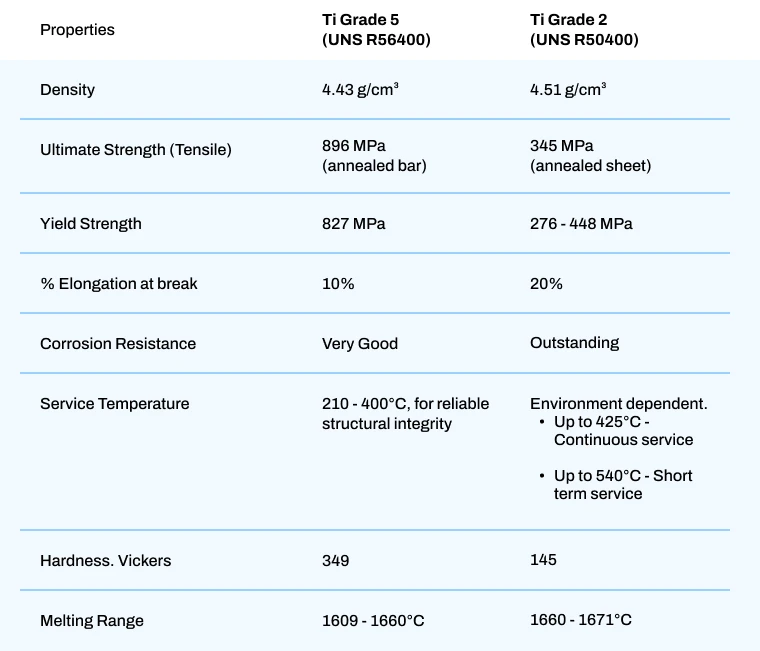
Titanium grade 5 or Ti 6Al-4V is the most widely used of all Titanium grades. It is typically available in the annealed condition and is readily heat treatable to increase strength for a wide range of applications. As a general-purpose alloy, Ti 6Al-4V has a broad spectrum of desirable properties at temperatures around 210°C – 400°C.
Ti 6Al-4V is an alpha-beta (α-β) alloy. It can be heat treated to give medium-high strength in sections under 100 mm thick. However, hardenability is limited and sections over 25 mm may not fully develop desired properties. Ti 6Al-4V has good weldability (with matching or ELI filler wire) and hot-formability. The degree of cold forming is, however, limited.
About Titanium Grade 2 (CP3)
Titanium Grade 2 or Titanium CP3 is a commercially pure alpha (α) alloy. Although not as strong as Ti 6Al-4V, Titanium grade 2 has outstanding corrosion resistance against a variety of aggressive media. For example, Titanium grade 2 is virtually immune to wet chlorine at 10°C – 80°C (0.001 mm/y) and thus, used to make chlorine dioxide mixers, pipework and fasteners in modern bleach plants.
Titanium grade 2 is specified based on its excellent corrosion resistance in environments which include: calcium chloride, cupric chloride, ferric chloride, various concentrations of acetic acid, high temperature seawater, most organic media and more. However, other conditions such as temperature, pH level and flow velocity could alter its properties drastically, e.g. susceptibility to stress corrosion cracking and crevice corrosion. When compared with Titanium grade 5, Titanium grade 2 is generally selected where aqueous corrosion resistance and/or formability are required.
At temperatures up to 200°C in normal atmosphere, Titanium grade 2 and other commercially pure grades are also a popular choice for lining material, when corrosion resistance is needed on the surface. Often cheaper and stronger steels are used as outer assemblies. One key application is lining of chimney stacks on coal fired power stations which have been retrofitted with FGD Systems (Flue Gas Desulphurisation plants).
Mechanical Properties Comparison
Chemical Composition
Titanium Grade 5
Titanium Grade 2
Further Reading
- Annealing: What Is It And How It Works - Introduction to Metal Alloy Heat Treatments
- Welding Titanium and Titanium Alloys
- Ti 6Al-4V (Grade 5)
- Titanium Grade 2 (CP3)
Need Advice on Titanium Grade Selection?
Choosing between Ti 6Al-4V (Grade 5) and Titanium Grade 2 (CP3) depends on your specific application requirements, including strength, corrosion resistance, formability and operating temperature.
NeoNickel's technical team can advise on titanium alloy selection for your specific application. Get in touch with the details of your project, and we'll help you select the most appropriate solution.
