
Seamless vs Welded Pipe: What’s the Difference?
If you are comparing seamless or welded pipe for a future project, there are several factors to consider before making a final decision. The manufacturing method affects characteristics including strength, cost, available diameter and surface quality, while the requirements of the application will ultimately determine which option is most suitable.
This resource compares seamless and welded pipe and does not cover the specific alloys used to manufacture them. You can find more information about the materials we supply on our website.
How Are Seamless and Welded Pipes Manufactured?
Seamless and welded pipes are produced using different manufacturing methods. Seamless pipe begins with a solid billet that is pierced to create a hollow tube, while welded pipe begins with coil or plate that is formed into a cylindrical shape and welded along the seam.
How Seamless Pipe Is Manufactured
The manufacture of seamless pipe begins with a high-quality billet. The choice of material affects the pipe’s strength, corrosion resistance and durability. From there, the manufacturing process involves several stages:
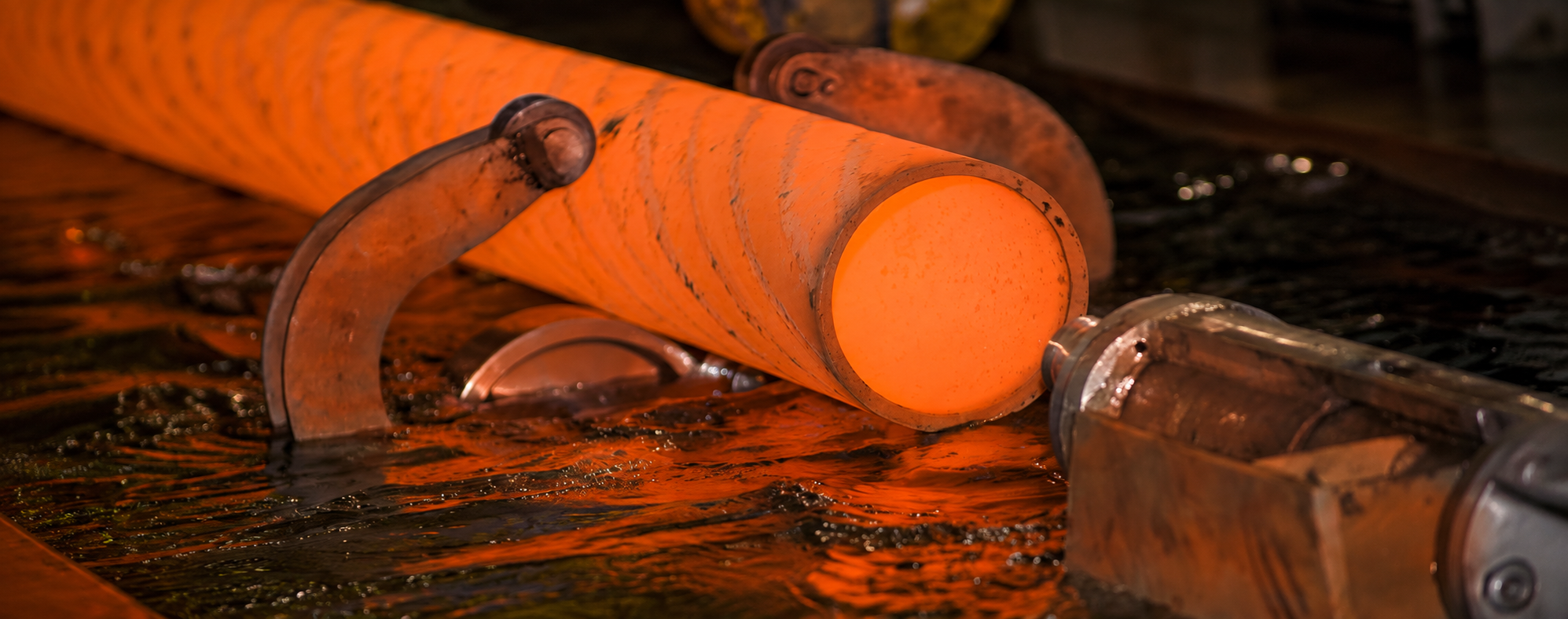
- Heating the billet: The billet is heated in a rotary furnace to make it malleable, usually to around 1200°C–1300°C. Correct heating ensures uniformity and prevents defects during rolling and piercing.
- Piercing: A hollow shell is produced by piercing the billet using a piercing mill or by extrusion. Two rollers spin the billet while a piercer pushes into the centre, forming a hollow tube.
- Rolling: The hollow tube is elongated and its wall thickness reduced using rolling mills. For smaller pipes, a mandrel mill is inserted to support the inner surface. Larger pipes use a plug mill, which supports the inner surface during rolling.
- Sizing and finishing: After hot rolling, the pipe may undergo stretch-reducing to achieve precise dimensions, including wall thickness. Cold drawing or rolling can further improve the surface finish, mechanical properties and dimensional accuracy.
- Heat treatment: The pipe is then heat treated as required, such as hardening, tempering or stress relieving. This enhances strength, resistance to thermal stress and toughness.
- Inspection and post-treatment: The finished pipe is cut to the required length, straightened and inspected. Inspection can include ultrasonic and/or hydraulic testing to ensure quality and safety, while post-treatments could include further surface polishing or coating.
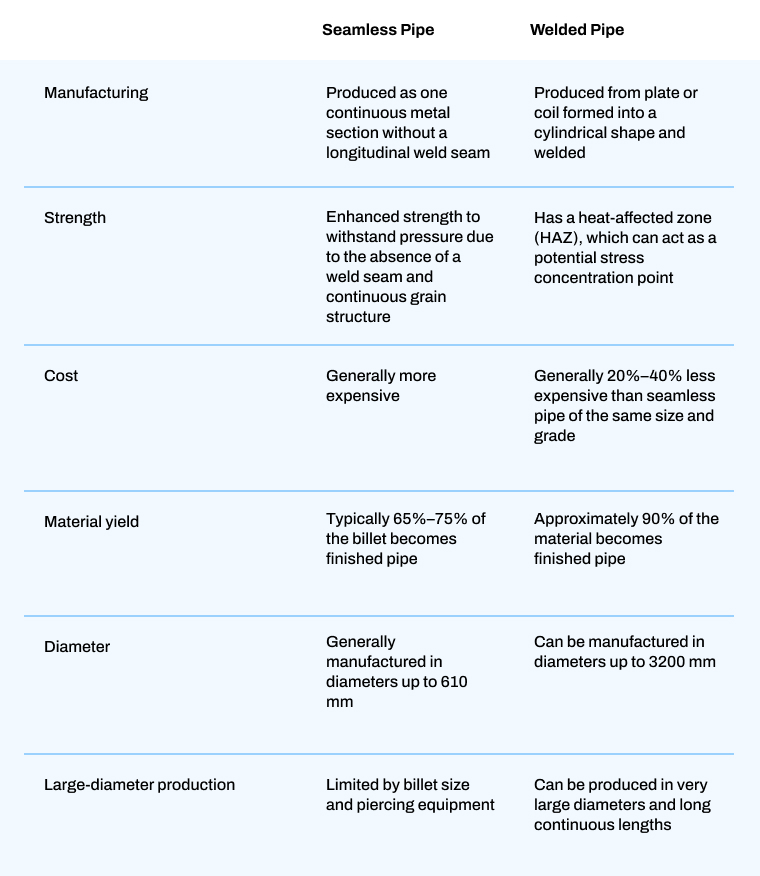
The seamless pipe produced contains one continuous metal section, which eliminates the need for a longitudinal weld seam. The grain structure of seamless pipe maintains its uninterrupted path throughout the entire pipe diameter, creating consistent mechanical characteristics.
The procedure demands significant energy consumption, and a seamless pipe mill typically converts only 65% to 75% of the billet into finished pipe. The remaining 25% to 35% becomes scale, trim and process scrap, with this low yield rate resulting in higher production costs for seamless pipe manufacturing. The production of large seamless pipe becomes impossible due to limitations on billet size and restrictions on piercing force.
How Welded Pipe Is Manufactured
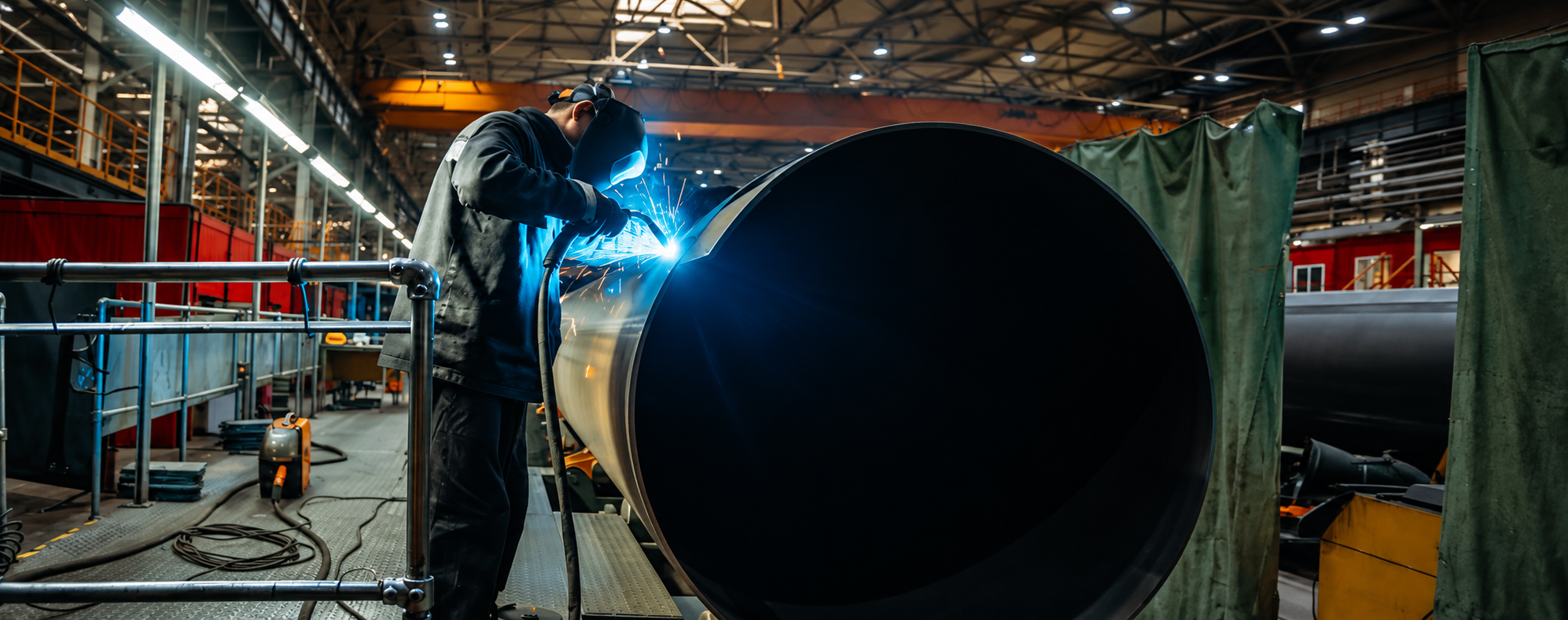
Manufacturing welded pipe begins by selecting the starting material, usually coils or plates, which are thoroughly checked to ensure there are no defects. The coils are unrolled and flattened to prepare for the shaping process before the edges are cleaned and straightened. This is a critical step in achieving a strong and consistent weld.
The prepared flat sheet of material is then passed through rollers that gradually bend it into a cylindrical shape. The edges of the formed cylinder are welded together, usually using one of three methods:
- Electric Resistance Welding (ERW): An electric current is passed through the edges to heat them until they melt and fuse together without adding filler material. ERW is the most common method for pipe diameters up to DN¹ 600.
- Longitudinal Submerged Arc Welding (LSAW): The longitudinal seam is welded using submerged arc welding. LSAW is used for large-diameter pipe, typically DN 400 to DN 1600.
- Spiral Submerged Arc Welding (SSAW): A steel coil is formed into a spiral and the spiral seam is welded continuously. SSAW is used for very large diameters and long-distance pipelines.
After welding, the excess material is removed from the weld joint to create a smooth finish. The pipes then undergo heat treatment to relieve stress and improve mechanical properties before being cut to the desired lengths and sizes. Finally, the pipes undergo extensive quality checks to ensure they meet the relevant industry standards.
Welded pipe typically creates around 10% waste, converting 90% of the material into the finished product. Making welded pipe is significantly less expensive than making seamless pipe because the overall process is faster and less energy intensive. Diameter flexibility is another advantage, as welded pipe starts from plate or coil and can therefore be produced in very large diameters that are impossible to manufacture as seamless pipe.
¹ DN = Diameter Nominal, often referred to as NPS (Nominal Pipe Size - USA). DN 50 = NPS 2. DN 600 = NPS 24. Also referred to as Nominal Bore.
Seamless vs Welded Pipe: Key Differences
The different manufacturing methods result in several practical differences between seamless and welded pipe. Strength, cost, available diameter and surface quality are all important considerations when deciding which option is suitable for an application.
Strength
Due to the absence of a weld seam and with a continuous grain structure, seamless pipe has enhanced strength to withstand pressure when compared with welded pipe. Welded pipe has a heat-affected zone (HAZ) created during the welding process, which can act as a potential stress concentration point.
Cost
Welded pipes are generally more cost-effective, costing 20% to 40% less than seamless pipes of the same size and grade. This is due to less waste material and the lower energy requirement to produce welded pipe.uid material which then condenses as a thin film or coating on the material.
Size Availability
Seamless pipes are generally manufactured in diameters up to 610 mm, with limitations determined by the capacity of the piercing equipment and the size of billets. The manufacturing process for welded pipes can produce a much bigger diameter of up to 3200 mm, as well as long continuous lengths when required.
Surface Quality
The choice of surface finish is critical as it affects several performance characteristics, such as flowrate, corrosion resistance, cleanliness and compliance. It also affects the appearance of the finished pipe. Generally, before any further treatments, seamless pipe is rougher due to the extrusion process versus the forming process.
Types of surface finish include:
- Brightness: Refers to reflectivity of the surface, typically either low gloss or high gloss.
- Roughness: Based on the smoothness and geometry of the surface.
- Mechanical finish: Used to enhance the surface, including mill finish and polished finish.
- Chemical finish: Treatments like passivation and pickling enhance corrosion resistance by removing contaminants from the surface.
- Special finish: Further options for specific applications include bead blasting, sandblasting and physical vapor deposition (PVD).²
² __Physical Vapor Deposition: a vacuum process which vaporises a solid or liquid material which
then condenses as a thin film or coating on the material.
Pipe Standards for Seamless and Welded Pipe
The ASTM standards system helps ensure quality and gives buyers and engineers confidence that the material meets exact requirements.
ASTM B444: Seamless Pipe and Tube
ASTM B444 covers products made from solid metal with no welds, used for high-pressure, high-stress applications where weld quality can’t be risked.
ASTM B705: Welded Pipe
ASTM B705 covers pipe made by forming and welding plate or strip metal. It is often cheaper for larger pipes or systems under low pressure where a weld seam is acceptable.
³ Tube is used for structural support, mechanical components, heat exchangers, instrumentation and medical tubing. Pipe is mainly used to transport fluids and gases used in industrial pipelines, chemical plants and power systems.
Testing Requirements for Welded Pipe
The material is certified. Welding procedures must be approved and visually inspected, while non-destructive testing will include ultrasonic testing to detect internal defects and mechanical testing to determine exact properties such as yield strength and ultimate tensile strength (UTS).
These tests are critical for the safe and efficient operation of welded pipes, including gas installations and other critical applications.
When Should You Use Seamless Pipe?
There are five situations where seamless pipe should be considered:
- High-pressure service: Boilers, pressure vessels and hydraulic lines above 2,000 psi.
- High-temperature service: Superheater tubes and furnace components above 500°C.
- Corrosive environments: Offshore platforms, chemical processing and sour gas (H₂S) service.
- Critical safety applications: Nuclear piping, subsea pipelines and LNG transfer lines.
- Small-bore instrumentation: Tubing under DN 50 where weld beads restrict flow.
When Should You Use Welded Pipe?
There are four situations where welded pipe should be considered:
- Structural and architectural use: Handrails, frames and columns.
- Water and drainage systems: Municipal supply and wastewater.
- Large-diameter pipelines: Transmission lines above DN 600.
- Budget-sensitive projects: General service with moderate pressure and temperature.
Seamless or Welded Pipe: Which Should You Choose?
The final choice between seamless or welded pipe should be based on the specific operational needs, applicable code standards and available financial resources. Your application dictates the right choice. Seamless pipes win on pressure rating, strength and corrosion resistance, while welded pipes win on cost and large-diameter availability.
Choose seamless pipes for high-pressure, high-temperature and corrosive applications. Welded pipes are ideal for structural, low-pressure and cost-effective projects. If you need help selecting the right pipe or material for your application, get in touch with the NeoNickel team to discuss your requirements.
