
Round Bar Tolerances
Round bar tolerances define how much a bar's actual size is allowed to vary from its nominal (specified) size. The data given is not intended to replace that shown in individual standards to which reference should always be made. The most important tolerance is diameter but straightness and ovality are also specified. Tolerances depend on the manufacturing method, applicable standards and bar finish.
Table of Contents
- Round Bar Tolerances
- Round Bar Standards
- Typical Diameter Tolerances
- Typical Straightness Tolerances
- Typical Ovality (Out of roundness) Tolerances
- Typical Length Tolerances
- Surface Conditions
- Examples
- Round Bar Specifications
Round Bar Standards
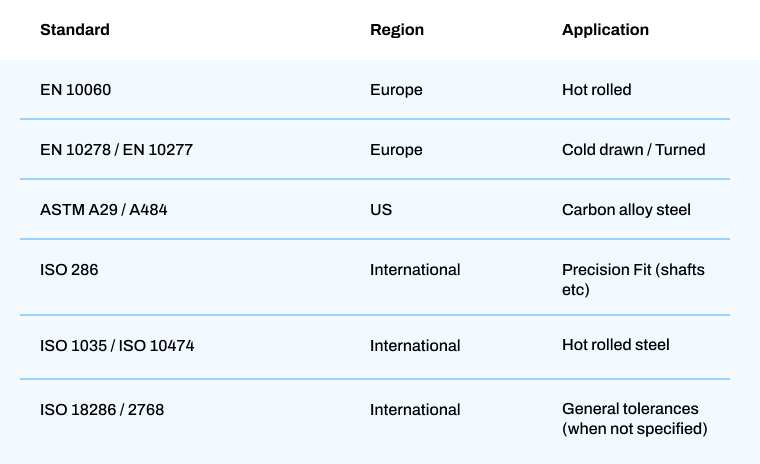
Both EN and ISO standards are part of the international and European standards system; but they serve different purposes and may have different requirements. EN 10060 is specifically a European standard for steel products, while ISO standards are part of the global ISO/IEC standardisation system. Therefore, it is essential to refer to the specific context and requirement for each standard.
Standards: Bar Types
Typical Diameter Tolerances
Diameter is measured at least 150 mm from the end of the bar. Cut-to-length diameter is measured at least 10 mm from the end of the bar.
Diameter Tolerances by Manufacturing Method
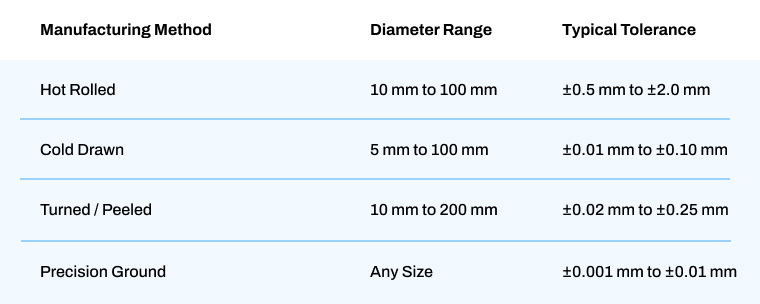
- Hot Rolled = coarse tolerance
- Cold Drawn = medium/precise tolerance
- Ground = very tight tolerance
Typical Straightness Tolerances
Measured by placing a 1 meter straight edge on the bar and measuring the gap between bar and straight edge.
Straightness by Manufacturing Method
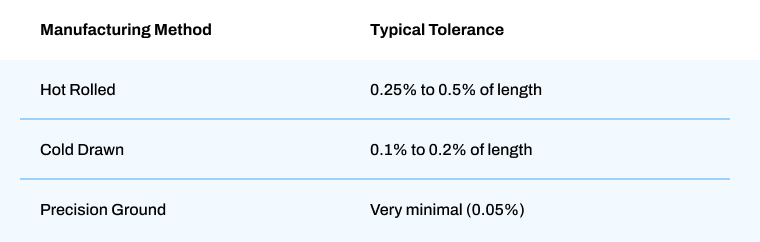
Example: 6 meter Bar - 0.2% straightness with max deviation = 12 mm.
Typical Ovality (Out of roundness) Tolerances
Round bars are not perfectly circular. The difference between the maximum and minimum diameter at the same measurement point is called ovality. Typically limited to 50% – 75% of the diameter tolerance.
Example: If the diameter tolerance = ±0.10 mm. The ovality tolerance = 0.05 to 0.075 mm.
Typical Length Tolerances
Round bars can be supplied in several length formats, depending on the application and customer requirements:
- Random lengths
- Fixed lengths
- Cut-to-length

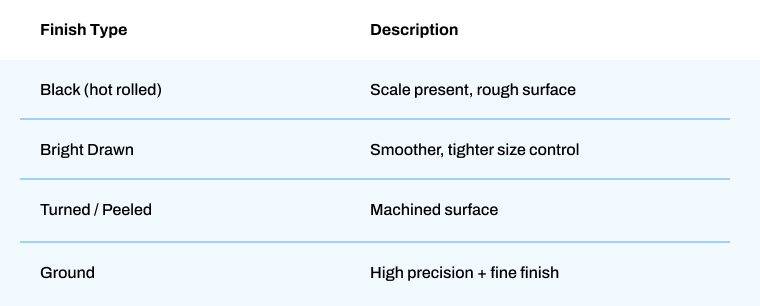
Surface Conditions
Surface condition can affect tolerances.
Examples
Structural Bar
- 40 mm hot rolled
- Tolerance ±0.8 mm
- Acceptable range: 39.2 mm to 40.8 mm
- Used for general structural applications where tight precision is not critical
Machined Shaft
- 25 mm bright drawn
- Tolerance 24.948 mm to 25.00 mm
- Used where parts must fit precisely and alignment is important
Precision Component
- 10 mm ground bar
- Tolerance ±0.005 mm
- Used in high-precision assemblies requiring extremely tight dimensional control
Round Bar Specifications
Specifications for bar products are broadly broken down into two categories:
-
Product Specifications: Alloy specific specification that establishes requirements for chemistry, mechanical properties, and other specific requirements often related to material properties.
-
General Requirements: A specification that establishes requirements such as tolerances, marking, packaging, etc. for a specific type and form of material.
Stainless Steel Bar Specifications
Several ASTM specifications cover stainless steel bar products, with each specification applying to different grades and applications.
- ASTM A276 covers dozens of different stainless steel grades, including austenitic, ferritic, duplex, and martensitic grades.
- ASTM A479 is another comprehensive stainless steel bar specification covering many of the same grades as ASTM A276. However, it is specifically intended for bars used in boilers and pressure vessels.
- ASTM A564 is the product specification for precipitation-hardening stainless steels.
- ASTM A582 is the product specification for free-machining stainless steels, which are designed specifically to improve machinability.
Nickel-alloy Bar Specifications
Each Nickel alloy product has a specific product specification or belongs to a product specification containing alloys of similar composition or use.
AMS Specifications
AMS specifications differ from ASTM specifications. Unlike ASTM standards such as A276 and A479, there are no comprehensive product specifications covering multiple stainless steel bar grades. Instead, each stainless steel and nickel alloy bar grade has its own dedicated AMS product specification.
- AMS 2241 contains the dimensional tolerance requirements for stainless steel bar.
- AMS 2261 contains the dimensional tolerance requirements for nickel alloy bar products.
Speak to the NeoNickel Team
For advice on round bar tolerances, specifications or the right material for your application, the NeoNickel team is on hand to help. Contact us today to discuss your requirements.
