
Ferrite Content in Austenitic Stainless Steels
This article explains ferrite content in austenitic stainless steels, including how it forms, why it affects the performance of the finished material, and how its presence can be predicted, measured and controlled during processing and welding.
While the basic 300 series stainless steels are essentially non-magnetic in their annealed condition, casting, cold working and welding can all introduce some ferrite into the structure. Understanding when and why this happens is important, as ferrite can affect both corrosion resistance and magnetic performance in service.
About Ferrite in Austenitic Stainless Steels
Ferrite metal alloys were first created by Drs. Yogoro Kato and Takeshi Takei in 1930 at the Tokyo Institute of Technology. The basic 300 series stainless steels materials, like 316L, have an austenitic microstructure and are non-magnetic. In the annealed condition they are essentially free of ferrite, which is magnetic.
Cast products of these alloys typically have some ferrite present. These alloys also form some ferrite when they are cold worked or work hardened. In both cases, the products will show a magnetic tendency.
Why Ferrite Content Matters
Ferrite can be detrimental to corrosion resistance in some environments. There are also applications where magnetic characteristics interfere with the performance of the end product. Alloy composition, temperature and cooling rate influence the presence of ferrite in steel and can significantly impact the mechanical, magnetic and corrosion properties.
Factors That Influence Ferrite Formation
Carbon, nitrogen, nickel and manganese are strong austenite formers, and increasing their content in the alloy will reduce the tendency for ferrite formation. There are several different methods of predicting ferrite content, but one of the more common is the DeLong diagram.
Ferrite reduces the tendency for the steel to experience solidification cracking during cooling. It is not uncommon for alloy 304 castings to contain 8% to 20% ferrite. The cast ingot composition of wrought 304 stainless is also balanced to have 1% to 6% ferrite, since this reduces the chance of cracking during forging or hot working.
Solution Annealing and Ferrite
Solution annealing will dissolve most of the ferrite that was retained as a result of the ingot solidification. Because cast products are balanced to have a higher amount of ferrite, annealing will not transform all of it to austenite. However, in an annealed wrought product, little or no ferrite will remain.
Predicting Ferrite Content with the DeLong Diagram
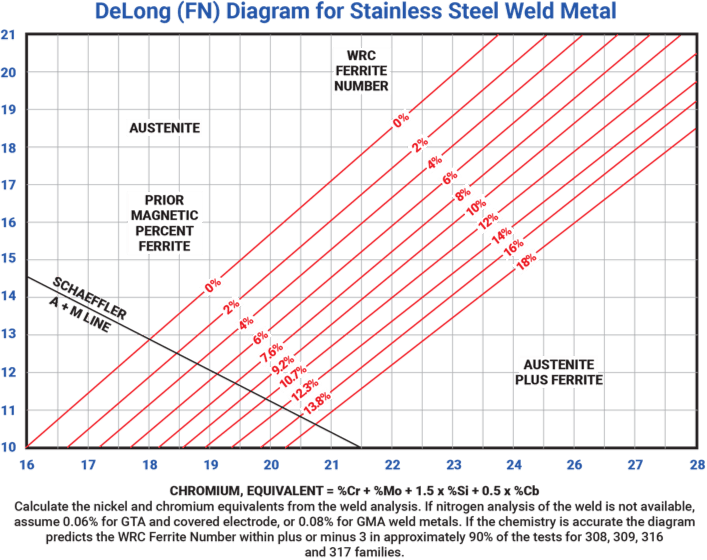
The DeLong diagram is also a predictor of the amount of ferrite likely to be present in a weld deposit made from the wrought product. Plotting the composition of the wrought plate or bar product will indicate how much ferrite might be present if the material were re-melted (i.e. welding), but it is not a valid indicator of the ferrite content in the annealed product.
Measuring Ferrite Content in the Finished Product
Ferrite content in the actual product can be determined through laborious metallographic examination or by using sensitive magnetic instruments in a laboratory setting (magnetic permeability). However, in most cases the use of comparative calibrated magnets can establish the approximate ferrite content within 0.5% to 1%. The testing of standard annealed 304, 316, 309 and 310 yields values of 2% or less. The ferrite contents are usually less than 0.5%.
Ferrite in Welding Filler Metals
It should also be noted that the matching filler metals used to join these alloys will also have higher ferrite contents. This is a precaution against solidification cracking, during welding. The ferrite contents in the weld deposits will be on the order of 5% to 10% ferrite depending on the alloy.
If ferrite free welds are also required, higher nickel alloy filler should be selected, such as Alloy 20 or Alloy 625.
Further Resources
Need Advice on Ferrite Content or Alloy Selection?
Managing ferrite content in austenitic stainless steels is important where corrosion resistance, magnetic performance or welding integrity are critical factors. Selecting the correct alloy grade, processing route and filler metal can significantly influence the performance of the finished product.
NeoNickel's technical team can advise on alloy selection, welding consumables and processing routes for your specific application. Get in touch with the details of your project, and we'll help you select the most appropriate solution.
