
Common Alloying Elements and Their Effects

Alloying elements play an important role in determining the mechanical properties, corrosion resistance and overall performance of metallic materials. By adding specific elements to a base metal, manufacturers can produce alloys with characteristics tailored to specific applications and operating environments.
This guide explores the definition of an alloy, why alloying elements are added and how common alloying elements influence material properties.
What Is an Alloy?
An alloy is created by combining two or more metallic elements to improve the properties of a base metal. The term alloy can be used as both a noun and a verb.
-
Noun: A metal made by combining two or more metallic elements, especially to give greater strength or resistance to corrosion. Example: 625 is an alloy containing Nickel, Chromium, Molybdenum and Niobium.
-
Verb: To mix metals together to make an alloy. Example: Alloying tin with copper produces bronze.
Why Are Alloying Elements Added?
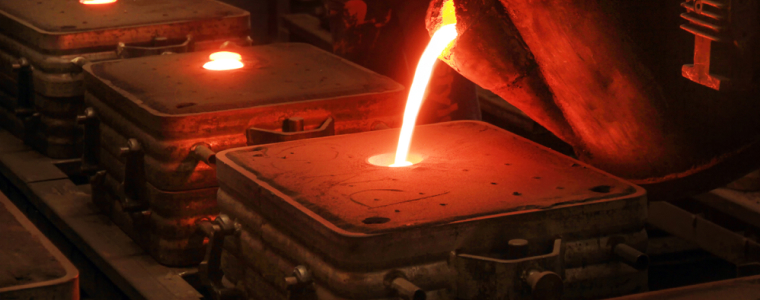
To create today’s specialist alloys, it is common for different elements to be added to a base metal. The starting base metal could be Iron, Nickel, Titanium, Aluminium and other metallic elements.
The addition of different elements can significantly alter the characteristics of the base metal, providing precise and desirable properties for specific applications and operating environments.
More generally, alloying elements can make an alloy:
- Stronger
- Harder
- More corrosion resistant
- More heat resistant
- Easier to machine
- Easier to weld
- Easier to form
A simple example is the production of steel by adding Carbon to an Iron base. The result is that steel is harder and more flexible than Iron alone.
How Alloying Elements Affect Material Properties
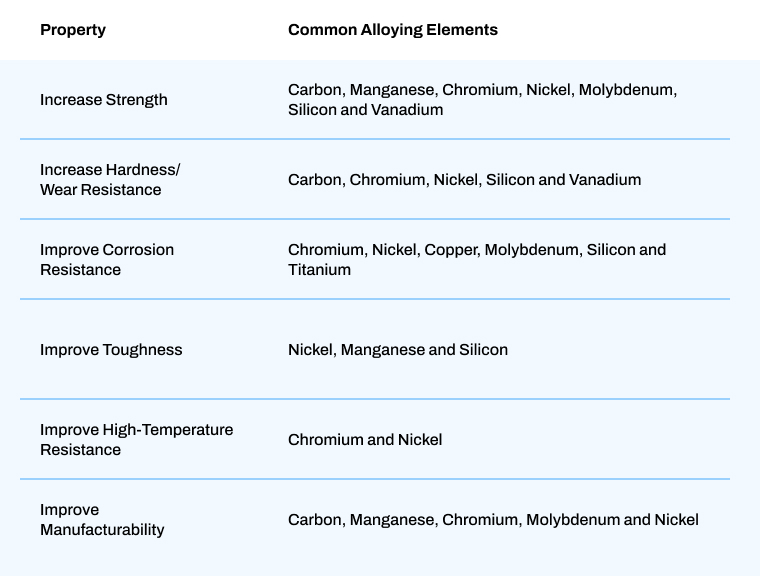
Different alloying elements are added to achieve specific material properties. The table below shows the common properties that can be improved and the alloying elements typically used to achieve them.
Properties and Alloying Elements
Main Alloying Elements
Aluminium (Al)
Aluminium reacts with dissolved Oxygen in steel to form Aluminium Oxide, which deoxidises the steel and helps create a finer grain structure, improving strength and toughness.
Boron (B)
Even tiny amounts greatly increase the hardenability in steels.
Carbon (C)
Carbon is a crucial component of iron alloys because it significantly enhances the mechanical properties of iron, transforming it into stronger and more versatile materials like steel and cast iron.
The presence of carbon allows for various phase transformations in iron. These different phases have distinct properties and are critical for tailoring the material’s performance through heat treatment processes.
Chromium (Cr)
Chromium is a key ingredient in stainless steel, which contains a minimum of 10.5% Chromium, improving corrosion resistance, wear resistance and hardness.
Cobalt (Co)
Improves high-temperature hardness, enhances resistance to oxidation and corrosion, wear resistance and cutting tool performance.
Copper (Cu)
Improves resistance to atmospheric corrosion, enhances conductivity and slightly increases strength.
Manganese (Mn)
Improves strength, hardenability, wear resistance and resistance to cracking during hot working. Manganese improves the weldability of steel while reducing brittleness, especially in high-temperature applications.
Molybdenum (Mo)
Improves high-temperature strength, creep resistance and hardenability. Enhances corrosion and oxidation resistance. Prevents pitting corrosion in chloride-rich environments such as seawater.
Nickel (Ni)
Significantly alters the microstructure of steel, increasing toughness, strength and corrosion resistance. Helps maintain mechanical properties at both high and low temperatures. Its magnetic properties make it a valuable addition in electrical and electronic devices.
Silicon (Si)
Increases strength and hardness, making the alloy suitable for tool steels and high-temperature applications.
Titanium (Ti)
Improves strength-to-weight ratio and corrosion resistance in some alloys. Titanium is lightweight, durable and biocompatible.
Vanadium (V)
Primarily used to enhance strength, toughness and wear resistance. Acts as a deoxidiser and improves strength, magnetic properties and weldability.
Need Help Choosing the Right Alloy?
Selecting the right alloy depends on your operating environment, performance requirements and intended application. Choosing the correct alloying elements helps achieve the right balance of strength, corrosion resistance, durability and manufacturability.
If you’re unsure which alloy is best suited to your project, the NeoNickel team can provide expert guidance and help you identify the most appropriate material. Get in touch with our team today to discuss your requirements or explore our range of specialist alloys.
