
What Is the Role of Nickel in Modern Metallurgy?
Nickel (Ni), with atomic number 28, is one of the most strategically important alloying elements in modern metallurgy. Its unique combination of corrosion resistance, ability to maintain strength at high temperatures and structural stability makes it indispensable across stainless steels, superalloys, plating technologies and advanced functional materials.
This article provides a technical overview of Nickel’s metallurgical behaviour, its interaction with Iron and other alloying elements, and its role in producing high-performance materials.
Fundamental Metallurgical Properties of Nickel
Crystal Structure and Phase Stability
Nickel crystallises in a face-centred cubic (FCC) lattice from room temperature up to its melting point of approximately 1455°C. This structure contributes to several of the properties that make Nickel valuable in engineering applications.
The FCC structure provides high ductility, even at cryogenic temperatures, allowing for significant deformation and easy shaping of the material. Its compact arrangement of atoms also contributes to the high strength of Nickel alloys, while alloys with an FCC structure tend to be less brittle. Together, these characteristics make the FCC structure fundamental to Nickel’s properties and its versatility across a wide range of engineering applications.
These characteristics also make Nickel valuable for stabilising the austenitic phase in Fe-Ni alloys. By providing a stable crystal structure capable of withstanding thermal and mechanical stress, Nickel plays an important role in stainless steels used in high-temperature and high-stress environments.
Corrosion and Oxidation Resistance
Nickel’s corrosion and oxidation resistance is due to the formation of a thin, stable protective oxide layer (NiO) on its surface when exposed to air or oxidising environments. Often referred to as the ‘passivation’ layer, this enhances resistance to pitting and crevice corrosion, improves performance in reducing environments and stabilises alloy resistance in sulphur-containing atmospheres. It also supports resistance to high-temperature oxidation.
These properties make Ni a critical alloying element in chemical processing and power generation industries.
Mechanical Behaviour
Nickel exhibits excellent mechanical properties, including high strength, ductility and corrosion resistance, at both low and high temperatures:
- High solid-solution strengthening capability: Nickel has a yield strength ranging from 59–172 MPa and an ultimate tensile strength (UTS) between 317–345 MPa, depending on the exact alloy and processing conditions.
- Yield strength: 70 MPa, at which Nickel begins to deform plastically.
- Brinell hardness: Approximately 700 MPa, indicating excellent resistance to surface indentation and scratching.
These properties form the basis of nickel-based superalloys used in aerospace and energy applications.
Metallurgical Role of Nickel in Alloy Systems
Nickel in Iron-Nickel Alloys
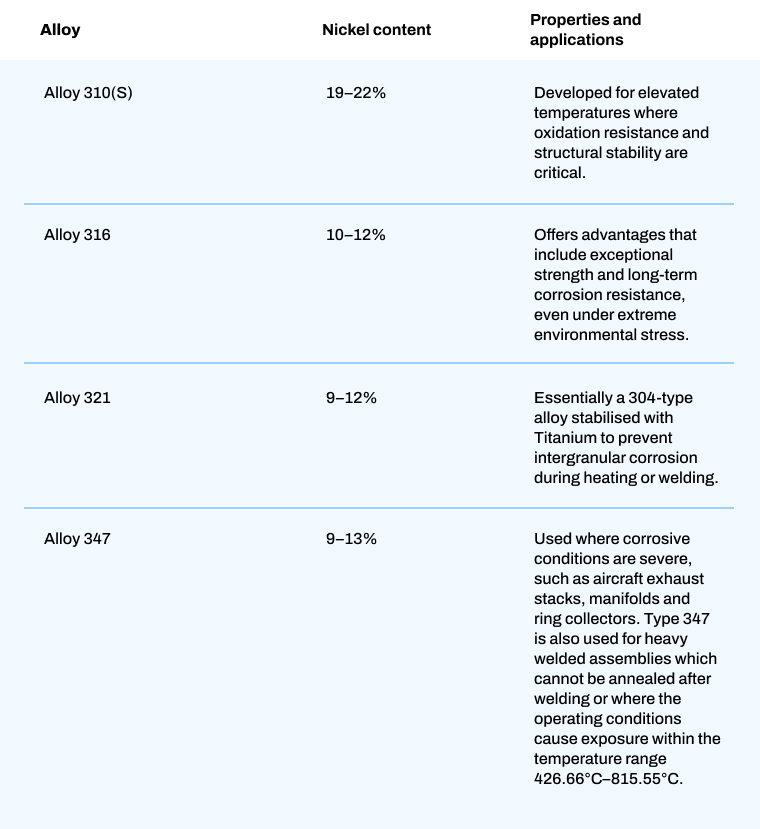
In Fe-based metallurgy, Nickel is a prime austenite stabiliser. Its role can be seen across a number of important alloy systems, including the 300 series of austenitic stainless steels and maraging steels.
Austenitic Stainless Steels: 300 Series
The 300 series of austenitic stainless steels are known for their high strength and excellent formability. These alloys are commonly used in various industries due to their corrosion resistance and ability to maintain strength at high temperatures.
Maraging Steels
Maraging steels have a Martensitic¹ structure with a carbon content of less than 0.03%. They combine extreme strength, toughness and dimensional precision with the ability to be machined and formed in a soft state. Their unique ageing process allows engineers to customise mechanical properties for specific high-performance applications.
Common non-stainless grades contain:
- Nickel: 17% to 19%
- Cobalt: 5% to 15%
- Molybdenum: 2% to 7%
- Titanium: 0.1% to 2%
- Aluminium: 0.05% to 0.2%
Due to their Nickel content, they are often referred to as the 18Ni family. They contain ultra-low carbon content, typically less than 0.03%, which is fundamentally different from traditional alloys which rely on Carbon for hardness.
Chromium is also sometimes added, further increasing the hardenability of the steel during the heat treatment as well as offering stainless steel corrosion resistance properties to the final product. Maraging steels are described by number, e.g. 200, 250, 300 or 350, indicating the approximate nominal tensile strength in thousands of pounds per square inch (ksi).
Strength is achieved through the precipitation of intermetallics. These act as obstacles that impede the movement of dislocations within the crystal structure. This process, known as precipitation hardening, increases the steel’s hardness and ultimate tensile strength. The ultimate tensile strength depends on the grade and heat treatment employed but is between 1400–2400 MPa.
¹ Martensite is formed when austenite (the face-centred cubic structure of Iron) is rapidly cooled or quenched.
Inconel®
Inconel® alloys are primarily composed of nickel-chromium, with varying amounts of Iron and other elements. The most common variants include:
- Alloy 600: A high-performance nickel-chromium-iron alloy designed to perform in elevated-temperature and corrosive environments.
- Alloy 625: A nickel-chromium-molybdenum-niobium alloy designed for use in extreme environments that demand exceptional corrosion resistance, high strength and superior weldability.
- Alloy 718: A precipitation-hardenable nickel-chromium alloy engineered for exceptional mechanical strength and corrosion resistance in extreme environments.
Inconel® alloys are also known for their ability to maintain mechanical strength and integrity in extreme heat, making them suitable for components exposed to high temperatures, such as turbine blades and exhaust systems.
Inconel® is the registered trademark of the Special Metals Corporation.
Monel®
Monel® alloys, on the other hand, are primarily made of nickel-copper with smaller amounts of Iron, Manganese and other elements. Monel® 400 is one of the most well-known variants.
While Monel® is not designed for high-temperature applications like Inconel®, it excels in resisting corrosion and stress corrosion cracking in marine and chemical environments.
Monel® is the registered trademark of Special Metals Corporation.
Alloy 200/201
When discussing Nickel alloys, it’s also important to mention Alloy 200/201. Nickel 200 and Nickel 201 are solid-solution-strengthened, commercially pure wrought alloys. The elemental restrictions of both alloys are combined into one, dual-certified chemistry, resulting in a single alloy with the desired characteristics of both alloys.
Alloy 200/201 contains a minimum of 99% Nickel.
Nickel-Based Superalloys
Nickel-based superalloys are designed to operate between 650°C–1050°C in turbines, jet engines and heat exchangers, while localised hotspots can be tolerated up to approximately 1200°C. Superalloys can be based on Iron, Cobalt or Nickel, with Nickel being best suited for aeroengine applications.
Key Microstructural Phases in Nickel-Based Superalloys
The essential solutes in nickel-based superalloys are Aluminium and/or Titanium. This generates a two-phase equilibrium microstructure consisting of gamma (γ) and gamma-prime (γ’). It is the γ’ which is largely responsible for the elevated-temperature strength of the material and its incredible resistance to creep deformation.
The γ-phase is a cubic-F (face-centred cubic) lattice with a random distribution of atoms. In contrast, γ’ has a cubic-P (primitive cubic) lattice in which Nickel atoms are at the face-centres and Aluminium or Titanium atoms are at the cube corners.
Grain boundary properties are also crucial for mechanical performance. Elements commonly added to nickel-based superalloys are Boron (B), Carbon (C) and Zirconium (Zr). These segregate at the grain boundaries, which improve creep strength and ductility. This is a key element in the engineering of Nickel-based superalloys as it directly affects an alloy’s resistance to high-temperature loads.
Superalloys retain mechanical integrity due to slow diffusion, phase stability and oxidation resistance.
High-Strength Nickel Alloys
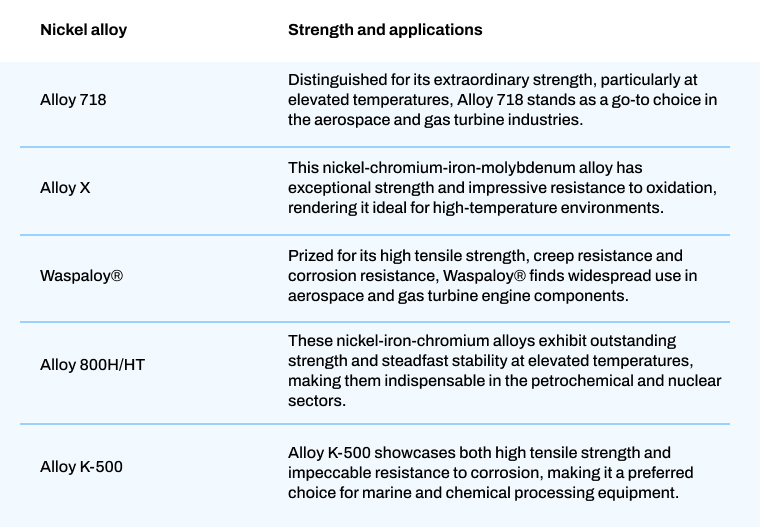
The strength of nickel alloys is a dynamic quality influenced by their composition and heat treatment. It is essential to recognise that the selection of a specific nickel alloy hinges on the particular requirements of an application, extending beyond strength to encompass factors such as corrosion resistance, heat tolerance and more.
Five nickel alloys are particularly celebrated for their remarkable strength in various applications:
Waspaloy® is the registered trademark of United Technologies Corp.
Corrosion-Resistant Nickel Alloys
The following nickel alloys are preferred choices in industries where corrosion resistance is paramount, such as chemical processing, oil and gas, and marine applications. Each alloy’s unique composition and properties cater to specific corrosive conditions, ensuring the longevity and reliability of critical components.
Six alloys are renowned for exceptional corrosion resistance:
Alloy 400
This nickel-copper alloy is known for its remarkable resistance to various corrosive elements, including seawater and chemical processing environments.
Alloy C276
As a versatile nickel-molybdenum-chromium alloy, C276 is celebrated for its outstanding resistance to a wide range of aggressive chemicals and acidic solutions.
Alloy 625
Exhibiting excellent corrosion resistance in both high-temperature and acidic environments, Alloy 625 is suitable for applications such as chemical processing and marine engineering.
Alloy 20
Alloy 20 offers superior resistance to corrosion caused by sulfuric acid, as well as other corrosive chemicals and environments.
Alloy 825
This nickel-iron-chromium alloy, with added copper and molybdenum, provides excellent resistance to corrosive media such as sulfuric and phosphoric acids.
Alloy B-2
A solid-solution-strengthened nickel alloy, Alloy B-2 is normally used in extreme reducing conditions. It also exhibits good resistance to hydrogen chloride, sulphuric acid and phosphoric acid.
Due to their chemical composition, nickel-based superalloys are extremely effective in resisting corrosion. Chromium and Molybdenum enhance the ability to form a protective oxide layer, which is essential in preventing corrosive attacks in environments such as chemical processing and marine applications.
Industries benefitting from this enhanced corrosion resistance include Aerospace, Power Generation, Chemical Processing and the Oil and Gas sector.
Heat-Resistant Nickel Alloys for High-Temperature Applications
A number of nickel alloys are critical in industries where exposure to extreme heat and temperature fluctuations is a constant challenge, including the aerospace, power generation and petrochemical sectors. Their specific properties ensure reliable performance under extreme conditions, making them essential materials for advanced engineering and technology.
Alloy 600
Celebrated for its outstanding resistance to high-temperature corrosion and oxidation, Alloy 600 is widely used in furnace components, heat-treating equipment and aerospace applications.
Alloy X
With its exceptional strength and resistance to oxidation, Alloy X excels in high-temperature environments, making it a popular choice for gas turbine engines and industrial furnace applications.
This nickel-chromium-tungsten-molybdenum alloy has excellent high-temperature strength and stability and is frequently employed in applications such as gas turbines and industrial heating equipment.
Alloy 800/800H
These nickel-iron-chromium alloys offer impressive resistance to high-temperature environments, making them suitable for heat exchangers, petrochemical processing and nuclear power plants.
Alloy 75
Known for its excellent creep resistance and ability to withstand high temperatures, Alloy 75 is used in gas turbine components and other high-temperature applications.
Rene 41
A precipitation-hardening nickel alloy that combines exceptional strength with heat resistance, making it ideal for aerospace components exposed to high temperatures.
Nickel in Surface Engineering
Nickel is widely used in electroplating and electroless coatings. Electrolytic Ni plating provides wear and corrosion resistance, while electroless Ni-P/Ni-B coatings enable uniform deposition on complex geometries. Hard Ni coatings are also used for tooling, moulds and electronic components.
These surface-engineered Ni layers provide hardness, tribological² improvements and aesthetic finishes.
² Tribological: the science of understanding friction, lubrication and wear.
Processing Considerations in Nickel Metallurgy
Melting and Casting
Nickel and Ni-alloys require strict control over several factors during melting and casting. Sulphur and Carbon impurities must be controlled to prevent hot cracking, while oxygen is often controlled through vacuum induction melting (VIM). Segregation control can be addressed by vacuum arc remelting (VAR) and powder metallurgy routes.
Nickel’s high-temperature stability also allows for advanced casting methods such as directional solidification and single-crystal growth.
Heat Treatment
Heat-treatment regimes vary according to the alloy class. Austenitic stainless steels typically undergo solution annealing followed by a rapid quench, while maraging steels are age hardened at 480–510°C. Nickel superalloys use multi-step ageing to optimise gamma-prime (γ′) precipitation.
These processes optimise mechanical and corrosion performance.
Joining and Fabrication
Nickel alloys are generally weldable, although several factors need to be considered during joining and fabrication. These include avoiding heat-affected zone (HAZ) sensitisation, limiting hot cracking through controlled heat input and using matching-filler materials for high-Ni welding.
Advanced techniques include laser, EB welding and diffusion bonding for aerospace components.
Future Trends in Nickel Metallurgy
Developments in Nickel metallurgy continue to expand its potential across advanced manufacturing and energy technologies. Key areas include:
- Additive manufacturing (AM) of nickel superalloys.
- High-entropy alloys (HEAs) incorporating Ni for lattice stability.
- Improved high-temperature fatigue resistance for aerospace.
- Growth in Nickel-rich Lithium-ion battery cathodes.
- Expanded use in hydrogen production and storage due to catalytic properties.
Why Nickel Remains Essential in Modern Metallurgy
Nickel remains one of the most versatile and strategically essential elements in metallurgy. Its ability to stabilise austenite, resist corrosion, enable high-temperature operation and enhance mechanical properties has cemented its role across stainless steels, superalloys, plating technologies and surface engineering.
As advanced manufacturing and energy technologies evolve, Nickel’s metallurgical significance will continue to expand, particularly in high-performance applications that demand extreme durability, structural stability and chemical resistance.
