
What are Duplex & Super Duplex Alloys?
Introduction
Duplex alloys were first developed in the 1930s by Avesta Ironworks in Sweden. The first generation of duplex stainless steels were called ‘duplex’ because of their mixed microstructure, containing approximately equal proportions of ferrite and austenite.
Today, duplex stainless steels are a family of alloy grades that, depending on their composition, offer varying levels of corrosion resistance. They typically have a Pitting Resistance Equivalent Number (PREn) ranging from 28–38.
The term Super Duplex was first introduced in the 1980s to describe highly alloyed, high-performance duplex stainless steels with a PREn greater than 40 and a minimum chromium content of 25%.
What is PREn?
PREn stands for Pitting Resistance Equivalent Number. It is a value developed through extensive research and testing to help indicate an alloy’s resistance to pitting corrosion.
Metallurgists determined that chromium, molybdenum and nitrogen are the key elements responsible for improving resistance to pitting corrosion. In some specialist steels, tungsten may also be added to the formula.
Although PREn is a useful comparison tool, it is not an absolute predictor of performance and should always be considered alongside other material properties and the environmental conditions in which the material will operate.
How is PREn Calculated?
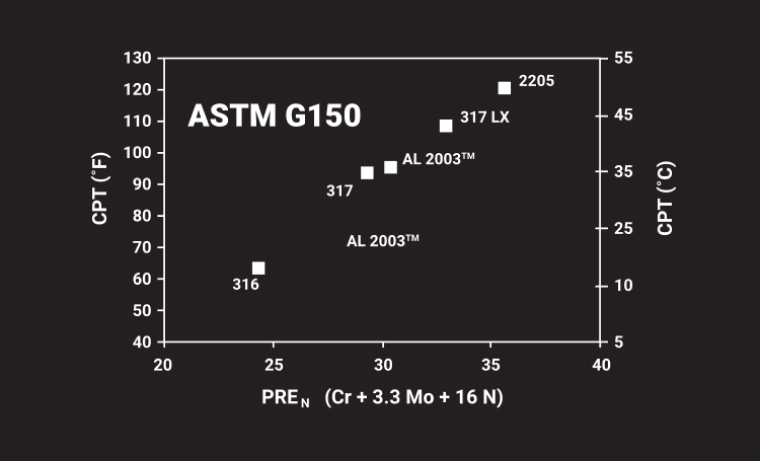
The most commonly used formula is:
PREn = % Cr + (3.3 × % Mo) + (16 × % N)
Where:
- Chromium (% Cr) forms a passive oxide layer that protects the steel.
- Molybdenum (% Mo) enhances resistance to localised corrosion.
- Nitrogen (% N) further improves pitting resistance.
The higher the PREn value, the greater the resistance to pitting corrosion.
How Engineers Use PREn
Engineers use PREn values to:
- Select materials that lower the risk of localised corrosion.
- Compare PREn values to identify higher-grade steels with improved corrosion resistance.
- Understand how an alloy’s chemical composition affects its performance.
Typical Composition Ranges and PREn
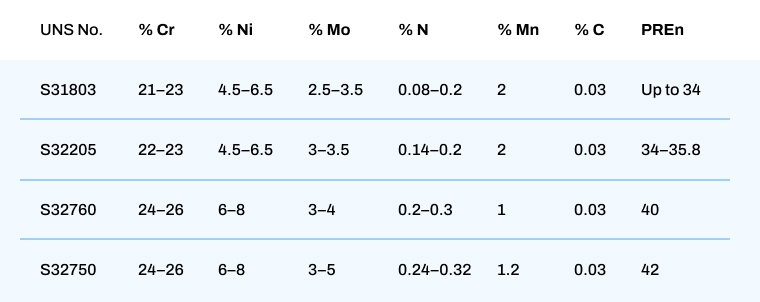
The table below indicates the typical composition ranges and average PREn values for the associated alloy grades.
It also highlights the importance of assessing each batch of material individually, as the exact manufacturing composition can influence the final PREn value.
Typical Composition Ranges
PREn Calculation Example
Using alloy S32750 as an example, the calculations below demonstrate how the PREn value can vary depending on the percentage of chromium, molybdenum and nitrogen within the alloy specification.
Assuming the lowest percentage content:
24 + (3.3 × 3) + (16 × 0.24)
= 24 + 9.9 + 3.84
PREn = 37.74
Assuming the highest percentage content:
26 + (3.3 × 5) + (16 × 0.32)
= 26 + 16.5 + 5.12
PREn = 47.62
Benefits of Duplex & Super Duplex Alloys
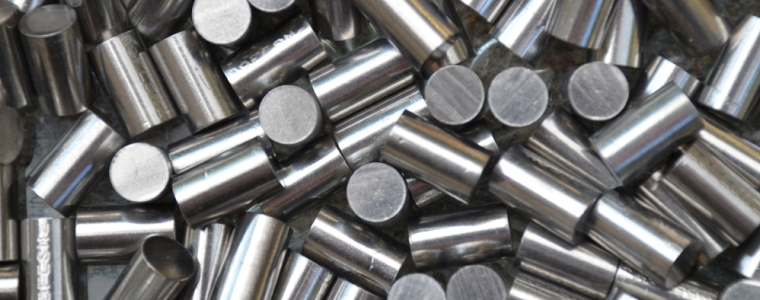
Duplex and super duplex alloys combine high mechanical strength with excellent corrosion resistance, making them suitable for a wide range of demanding industrial applications.
High Strength
Duplex and super duplex alloys provide significantly higher tensile strength than traditional austenitic stainless steels, making them suitable for load-bearing applications.
Corrosion Resistance
These alloys perform exceptionally well in environments with high chloride levels, offering excellent resistance to:
- Pitting corrosion
- Crevice corrosion
- Stress corrosion cracking (SCC)
Cost-Effective
Due to lower amounts of nickel and molybdenum content, duplex and super duplex alloys are more cost-effective than high nickel alloys, providing a balance of strength and corrosion resistance.
Weldability
Duplex and super duplex alloys are known for their superior weldability, with less likelihood of weld cracking and post-weld embrittlement compared to conventional ferritic stainless steels.
Durability
Their dual-phase microstructure provides a combination of strength and ductility, making them suitable for complex fabrications and installations.
These benefits make duplex and super duplex alloys a preferred choice for industries such as oil and gas, chemical processing and marine applications, where the ability to withstand harsh conditions while maintaining performance is critical.
Need Help Choosing the Right Duplex or Super Duplex Alloy?
Selecting the right duplex or super duplex alloy depends on your application’s performance requirements, operating environment and corrosion resistance needs. Choosing the correct grade can help ensure long-term performance in demanding conditions.
If you’re unsure which alloy is best suited to your project, the NeoNickel team can provide expert guidance and help you identify the most appropriate material for your application. Get in touch with our team today to discuss your requirements or explore our range of duplex and super duplex alloys.
