
Why Do Metals Corrode? Types of Corrosion Explained
Metal corrosion is one of the biggest challenges facing industries that rely on strong, durable materials. From marine engineering and chemical processing to power generation and construction, corrosion can weaken components, reduce operational efficiency and increase maintenance costs if left unchecked.
Understanding why metals corrode is essential when selecting materials for demanding applications. Corrosion-resistant metals and alloys are specifically designed to withstand harsh environments, helping to extend service life, maintain structural integrity and reduce the risk of failure.
Nickel alloys are widely recognised for their excellent corrosion resistance, with different grades offering varying levels of protection depending on the application. Many corrosion-resistant alloys also perform exceptionally well in aggressive chemical environments, high temperatures and marine conditions, making them suitable for a wide range of industries.
What Is Corrosion?
Corrosion is the gradual deterioration of a metal caused by chemical or electrochemical reactions with its surrounding environment. Depending on the material and operating conditions, corrosion can weaken structural integrity, reduce performance and ultimately lead to component failure.
Corrosion most commonly occurs when metals are exposed to:
- Moisture and water
- Saltwater or marine environments
- Aggressive chemicals and acids
- High temperatures
- Electrical reactions between different metals
The type of corrosion that develops depends on factors such as the material being used, the surrounding environment and the overall design of the component.
What Causes Metals to Corrode?
Metals naturally react with their environment in an attempt to return to a more chemically stable state. Exposure to oxygen, moisture, salts and aggressive chemicals can trigger reactions that gradually break down a metal’s surface over time.
Several factors can accelerate corrosion, including:
- Prolonged exposure to water or humid conditions
- Contact with aggressive chemicals or acids
- High operating temperatures
- Poor component design that traps moisture
- Contact between dissimilar metals in the presence of an electrolyte, such as seawater
Choosing the correct corrosion-resistant alloy helps minimise these risks and can significantly extend the lifespan of components operating in demanding environments.
Types of Corrosion
Corrosion can occur in several different ways depending on the operating environment and the design of the component. Understanding the different types of corrosion can help engineers and manufacturers select the most appropriate material for their application.
The table below compares the main types of corrosion before exploring each one in more detail.
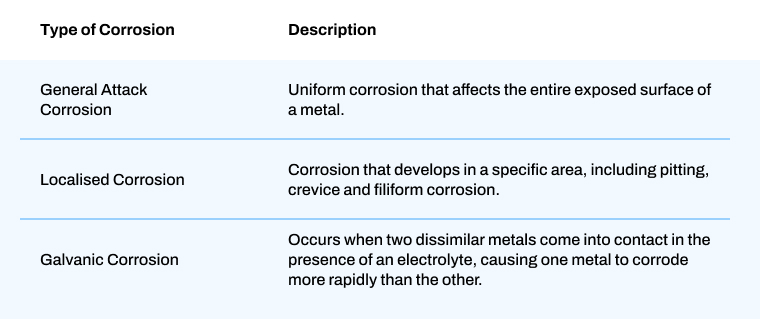
Each type of corrosion behaves differently and presents its own challenges. Understanding how they occur can help when selecting materials for specific operating environments.
General Attack Corrosion
General attack corrosion, also known as uniform corrosion, affects the entire exposed surface of a metal. It occurs as a result of chemical or electrochemical reactions and is one of the most common forms of corrosion.
Because deterioration occurs evenly across the surface, it is generally easier to predict and monitor than more localised forms of corrosion.
Localised Corrosion
Unlike general attack corrosion, localised corrosion develops in a specific area of a metal rather than across its entire surface. Although it may appear less severe, it can cause significant damage because deterioration is concentrated in one location.
Localised corrosion is commonly divided into three subcategories:
Pitting Corrosion
Pitting corrosion causes small holes or pits to form on the surface of a metal. While often difficult to detect, these pits can penetrate deep into the material and lead to unexpected component failure.
Crevice Corrosion
Crevice corrosion typically develops in confined spaces where moisture becomes trapped, such as joints, seals and fasteners. Standing water and limited oxygen circulation create conditions that accelerate corrosion within these narrow gaps.
Filiform Corrosion
Filiform corrosion occurs when moisture and oxygen penetrate beneath protective surface coatings. It spreads beneath the coating in thread-like patterns, damaging the underlying metal while often remaining hidden from view.
Galvanic Corrosion
Galvanic corrosion, also known as dissimilar metal corrosion, occurs when two different metals come into electrical contact in the presence of an electrolyte, such as seawater.
One metal becomes the anode and corrodes more rapidly, while the other acts as the cathode and is protected. This type of corrosion is particularly important to consider in marine, offshore and industrial applications where different metals are frequently used together.
What Is the Difference Between Rust and Corrosion?
Although the terms are often used interchangeably, rust and corrosion are not the same.
Corrosion is the general term used to describe the deterioration of metals through chemical or electrochemical reactions. It can affect many different metals and alloys, including stainless steels, nickel alloys and titanium.
Rust, however, is a specific type of corrosion that only affects iron and iron-based alloys, such as carbon steel. Rust forms when iron reacts with oxygen and moisture to produce iron oxide. As rust flakes away from the surface, fresh metal is exposed, allowing the corrosion process to continue until the material is significantly weakened.
Understanding the difference between rust and corrosion is important when selecting materials for environments where long-term durability and corrosion resistance are essential.
Why Are Corrosion-Resistant Metals Important?
Corrosion-resistant metals play a vital role across industries including marine, chemical processing, power generation, aerospace and architecture. Their ability to resist deterioration helps improve safety, reduce maintenance requirements and extend the lifespan of critical components.
When selecting materials for demanding environments, corrosion resistance is just one factor to consider. Many applications also require metals that offer:
- High strength and durability
- Resistance to aggressive chemicals
- Excellent load-bearing capabilities
- Good weldability and formability
- Long service life with reduced maintenance
Different metals and alloys provide varying levels of corrosion resistance, with specific grades designed to perform in challenging environments such as seawater, high temperatures and chemical processing facilities.
Marine Grade Corrosion-Resistant Alloys
Marine environments are among the most challenging operating conditions for metals due to constant exposure to saltwater, moisture and chloride-rich conditions. Marine grade alloys are specifically designed to withstand these corrosive environments while maintaining their mechanical strength and performance.
The table below highlights some of the most commonly used nickel alloys for marine applications.
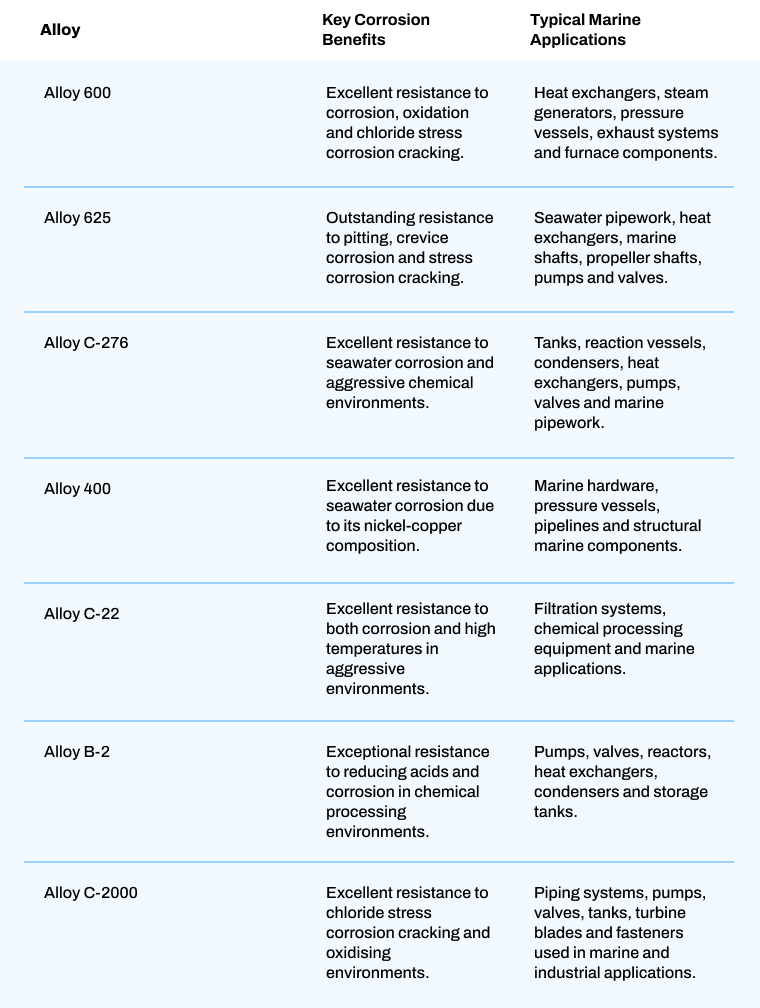
Marine-grade nickel alloys are widely used because they continue to perform in harsh saltwater environments where many conventional metals would rapidly deteriorate.
Heat-Resistant Corrosion-Resistant Alloys
Many corrosion-resistant nickel alloys also offer excellent resistance to high temperatures, making them suitable for demanding industrial applications where both heat and corrosion are present.
One of the most common applications is within heat exchangers, which transfer thermal energy between liquids or gases. Heat exchangers are widely used across the automotive, HVAC, power generation and chemical processing industries, where material performance is critical to efficiency and reliability.
The table below outlines some of the most commonly used heat-resistant nickel alloys and their typical applications.
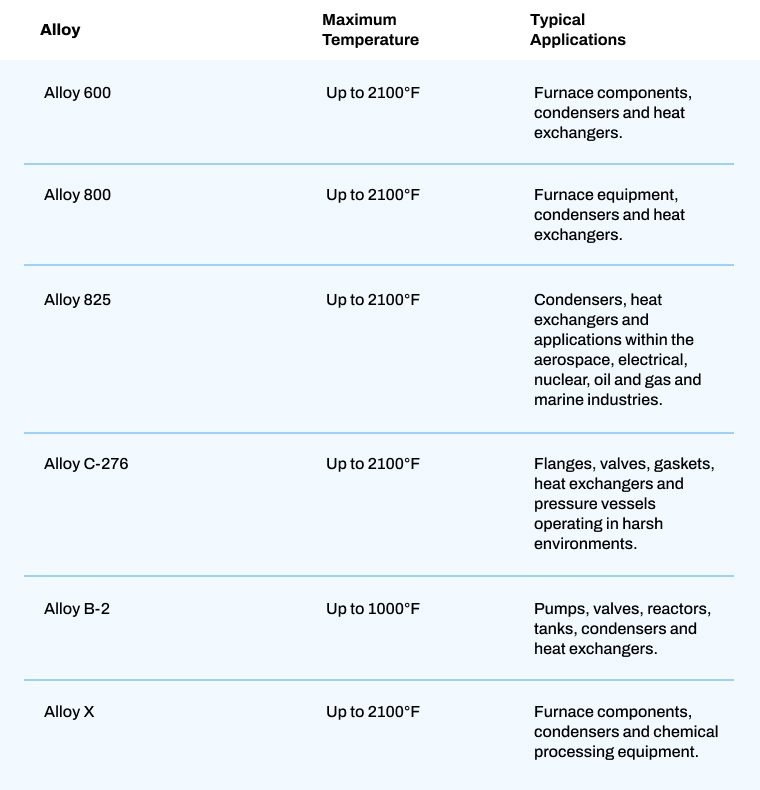
Heat-resistant nickel alloys combine excellent corrosion resistance with the ability to perform at elevated temperatures, making them ideal for applications where conventional materials would lose strength or degrade over time.
Whether your application involves exposure to seawater, aggressive chemicals or high temperatures, selecting the right corrosion-resistant alloy is essential for maximising performance, extending service life and reducing maintenance requirements. Understanding the different types of corrosion and how various alloys perform in demanding environments can help ensure long-term reliability and reduce the risk of premature component failure.
Need Help Choosing the Right Alloy?
Choosing the right alloy depends on several factors, including the operating environment, temperature, chemical exposure and mechanical performance requirements. With decades of experience supplying high-performance nickel alloys and corrosion-resistant metals, the team at NeoNickel can help you identify the most suitable material for your application.
Whether you need expert technical advice, support selecting the right alloy grade or more information about our product range, get in touch with our team today or make an inquiry to discuss your requirements.
